By Sheaikh Umar Faruque Al Hadi: Bangladesh–Japan economic relations are evolving beyond traditional development cooperation towards a broader partnership in trade, investment, infrastructure, technology and skills development. The signing of an Economic Partnership Agreement (EPA) on February 6 has opened a new chapter in bilateral ties. As Bangladesh’s first EPA, the agreement offers opportunities to expand trade, attract investment and strengthen the country’s competitiveness in global markets.
Commerce, Industries, Textiles and Jute Minister Khandaker Abdul Muktadir has stressed the importance of Japanese investment in accelerating industrialisation, facilitating technology transfer and creating jobs. He said the government was working to simplify business procedures, reduce administrative barriers and create a more investor-friendly environment.
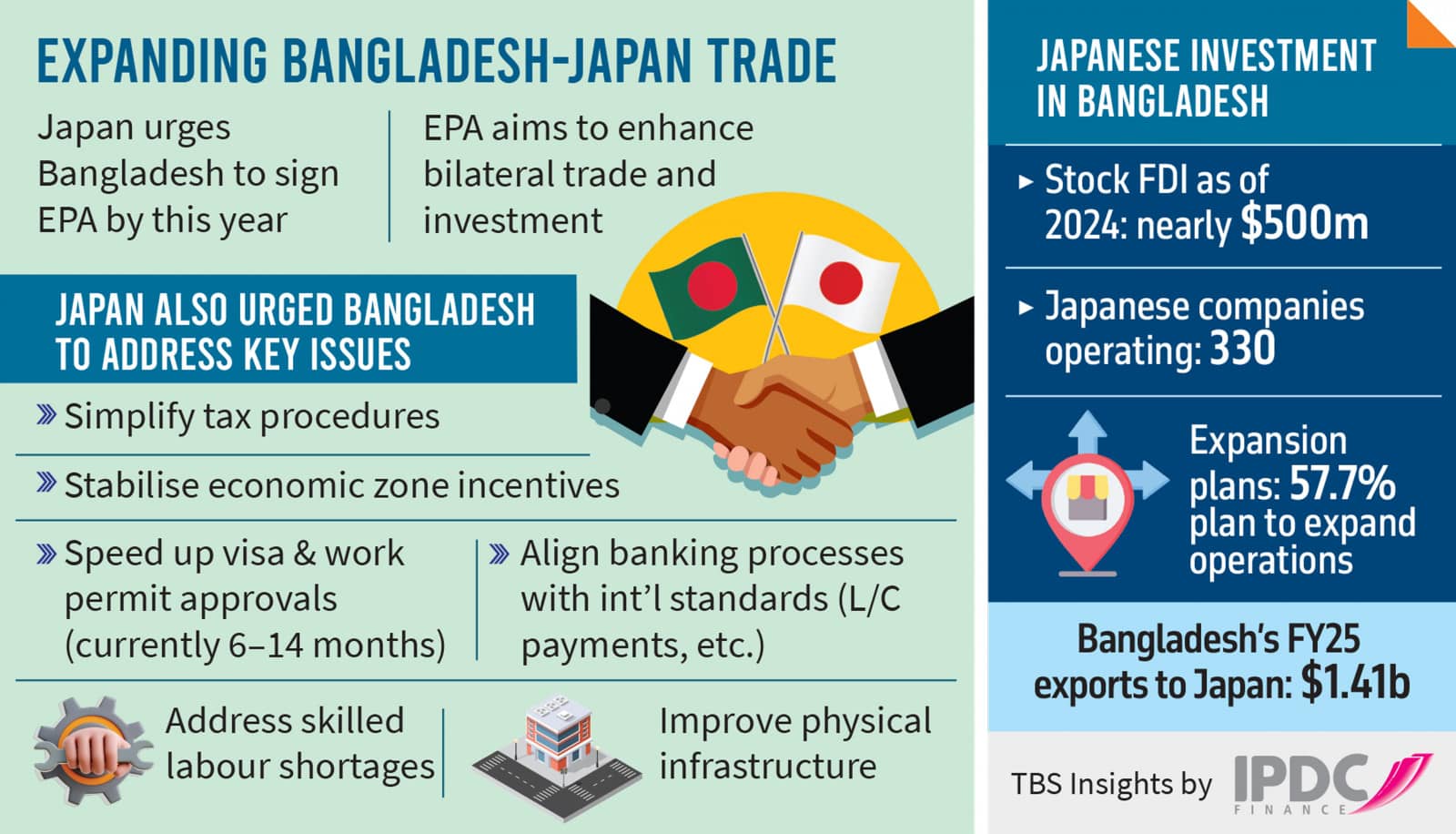
Japan has been a key development partner of Bangladesh since independence. Today, around 350 Japanese companies operate in the country, with others exploring opportunities to expand their presence. The challenge is to convert this longstanding partnership into greater private-sector investment, technology-driven production and export growth.
Infrastructure: Turning Projects into Economic Gains
Japan has played a significant role in major infrastructure initiatives, including Dhaka’s metro rail, the third terminal at Hazrat Shahjalal International Airport, the Matarbari deep-sea port and the Japanese economic zone in Araihazar, Narayanganj.
These projects could strengthen connectivity, reduce logistics costs and support export-oriented industrialisation. Matarbari, in particular, could improve access for larger vessels and connect Bangladesh more efficiently to global supply chains. The economic zone could attract manufacturing investment, while the metro rail is improving urban mobility in the capital.
However, the economic benefits will depend on timely completion, cost control and efficient operations. Delays in Metro Rail Line-1 and the withdrawal of major contractors, including Kajima Corporation, raise concerns about implementation risks. Prolonged uncertainty could undermine investor confidence and increase project costs.
The airport’s third terminal also presents an important opportunity. The government has targeted December 16, 2026, for the start of partial operations, while discussions between the Civil Aviation Authority of Bangladesh and a Japanese consortium on operational arrangements are ongoing. Full operations could begin by mid-2027, subject to the completion of contractual and operational preparations.
Where Investment Can Make a Difference
Bangladesh offers Japanese investors opportunities in garments and technical textiles, automobiles and components, light engineering, electronics, industrial machinery, information and communication technology, logistics, pharmaceuticals, medical equipment, agro-processing, renewable energy and healthcare.
Its large domestic market, young workforce, competitive production costs and strategic location provide important advantages. But cost alone will not determine investment decisions. Japanese companies also value consistent quality, reliable suppliers, timely delivery, skilled workers and predictable policies.
Bangladesh must therefore position itself as more than a low-cost manufacturing destination. Developing quality production facilities and integrating local industries into regional and global supply chains should be central to its investment strategy.
Cooperation can also extend beyond bilateral trade to technology-based services, healthcare, skills development and regional distribution. Japanese investment could help Bangladeshi firms improve productivity and access third-country markets.
Automobile Industry Faces a New Competitive Landscape
Japanese brands have long enjoyed a strong position in Bangladesh’s automobile market because of their reliability, durability and resale value. However, Chinese manufacturers are intensifying competition through lower prices, advanced features and an expanding range of electric vehicles (EVs).
Japanese companies could strengthen their position by investing in local assembly, component manufacturing and technology transfer, while expanding affordable hybrid and electric vehicle options. Such investment would support local industry, create jobs and develop technical skills.
Wider EV adoption, however, requires reliable electricity, charging infrastructure, accessible components and a coherent long-term industrial policy. These constraints must be addressed through coordinated public- and private-sector investment.
Policy Uncertainty Remains a Major Obstacle
Despite its potential, Bangladesh faces persistent barriers to foreign investment. Inconsistent application of tax, VAT and customs rules, changes to statutory regulatory orders without adequate notice, and disputes over HS code classification and customs valuation can increase costs and delay operations.
Slow VAT refunds, foreign exchange constraints, complex banking documentation, difficulties in repatriating profits and repetitive paperwork across government agencies add to the burden. High logistics costs, unreliable gas and electricity supplies, and shortages of skilled workers further weaken the investment climate.
Investment incentives alone cannot overcome these obstacles. Investors need transparent regulations, consistent enforcement, clear timelines for administrative decisions and confidence that policies will remain stable over the long term.
The government has repeatedly expressed its commitment to attracting Japanese investment. Translating that commitment into predictable rules and efficient public services is now essential.
EPA: Opportunity Must Be Matched by Competitiveness
The EPA is a strategic opportunity as Bangladesh prepares for the changes in trade preferences associated with graduation from the least developed country (LDC) category. It could provide a framework for expanding trade, investment, services and skilled labour mobility between the two countries.
But preferential market access will not automatically translate into higher exports. Bangladeshi businesses must meet Japan’s demanding standards for quality, safety, production processes and timely delivery.
Export diversification, technology adoption, stronger small and medium-sized enterprises, workforce development and joint ventures with Japanese companies will be crucial. Businesses also need clear information on the agreement’s provisions, rules of origin, market-entry requirements and available concessions to use its benefits effectively.
A Clear Agenda for Action
Bangladesh and Japan have an opportunity to build on decades of cooperation and establish a deeper industrial and commercial partnership. Realising that potential will require action on five fronts: simplifying investment approvals, ensuring consistent tax and customs policies, improving foreign exchange procedures, upgrading ports and energy infrastructure, and developing skills suited to Japanese industry.
Effective institutional coordination will also be necessary to monitor EPA implementation and resolve investors’ concerns promptly.
The EPA provides a framework, but its success will depend on what follows. If Bangladesh can deliver policy consistency, reliable infrastructure, skilled workers and a business-friendly environment, Japanese investment could become a stronger driver of industrialisation, technology transfer and export diversification over the next decade. Without these reforms, the opportunities created by the agreement may remain largely unrealised.

Bangladesh–Japan Economic Ties: Unlocking New Opportunities Through Policy Consistency